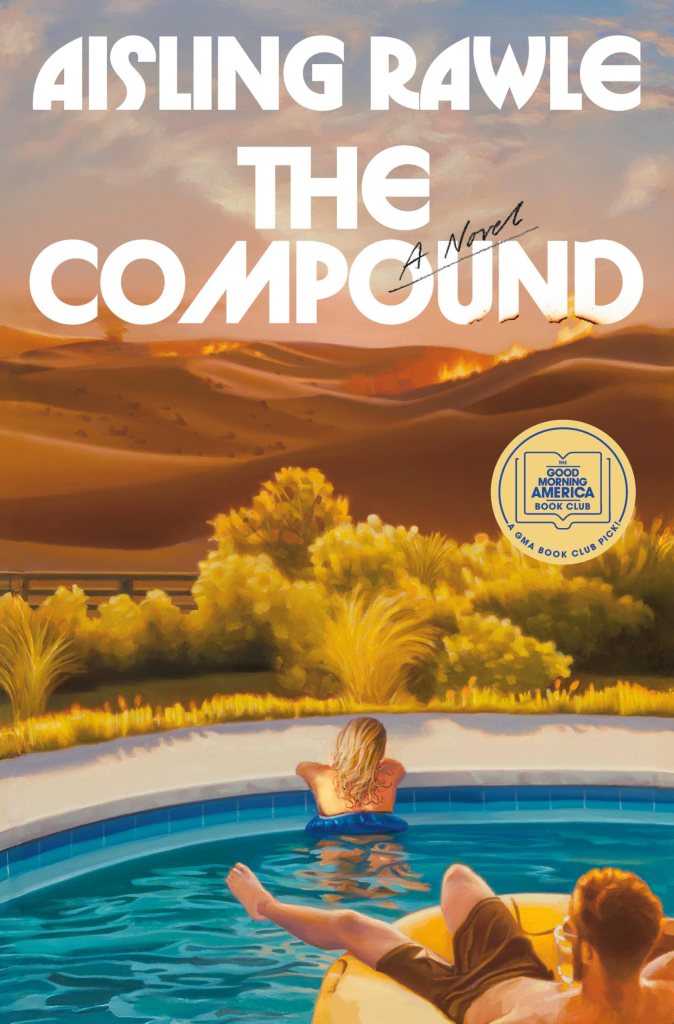
I picked this one up thanks to a New York Times recommendation, and it’s an assured debut for Irish author Aisling Rawle. It’s a tense psychological thriller set in a near-future world.
The Compound is the most popular reality show on television. In it, ten young women and ten young men live in the titular desert compound, surrounded by hidden microphones and cameras that record their every word and movement. They must complete communal tasks to win rewards for the group that make the compound more habitable, e.g. couches, blankets and food. They can also complete individual tasks for personal reward – jewellery, clothes and such. Contestants must share beds in boy-girl pairs, and anyone found sleeping alone at sunrise is banished from the compound. Additionally, the communal task occasionally involves voting to banish one of the contestants. The object of the game is, of course, to be the last remaining contestant.
The story follows Lily, a young, beautiful contestant on the show who has entered the contest as a way out of her dead-end retail job and boring life. We join the story as she wakes up in the compound, which appears to have been left in a state of some disrepair by the previous residents. She meets the other nine female contestants, and they begin tidying up the compound while they wait for the arrival of the male contestants, who must trek through the desert to get there.
When the boys arrive, there are only nine of them – one has been disqualified even before arriving at the compound – and some of them bear injuries that they say are from an animal attack. With ten girls and only nine boys, the competition is immediately underway, as one girl must now be eliminated at sunrise.
As the plot progresses and contestants compete against each other to be the last person standing, the show’s unseen producers set tougher, stranger and more divisive tasks. We find Lily learning about her fellow Compound inhabitants and the secrets they are hiding, and how this knowledge changes her allegiances and feelings towards them. We also see her gaining insights into herself, her desires and the nature of fame.
One might expect that in a book like this, chapters would be told from different contestants’ viewpoints, but Rawle wisely chooses to keep the action centred on Lily and does an impressive job of feeding out information about the show, its rules and the world it is set in as this information becomes needed and relevant. For example, we find out that the contestants are not allowed to acknowledge out loud that they are in a television show or talk about their lives in the real world (until this becomes a task). Likewise, she hints at the nature of the world outside the compound, where wars are being fought, economic prospects are bleak, and the climate crisis has escalated.
The Compound is a gripping read that casts a sharp eye at the nature of ambition, consumerism, voyeurism and the exploitation of emotion for entertainment. It’s definitely worth a look.
 Andrew Gilhooley's Blog
Leave a comment