As anyone who knows me can attest, I have a deep and abiding affection for Doctor Who, having watched it ever since I was a wee scrap of a lad sitting in front of the TV in the living room. (My first Doctor was Jon Pertwee, accompanied by his companion Jo Grant, played by Katy Manning, in case you’re interested.)
The first reincarnation that I witnessed was that of the Third Doctor into the Fourth. I still have a clear memory of watching the final episode of Planet of the Spiders and seeing Jon Pertwee’s curly white hair change into Tom Baker’s curly dark hair, his face blurring and changing until a new incarnation of the Doctor was lying there on the floor. Cue the end credits!
It was the 8th of June, 1974, and we would have to wait until the 28th of December that year to see what this new version of the Doctor was going to be like. We had no idea that we were about to embark on one of the most well-regarded periods in the show’s history.
Fast forward to late December, in between the Christmas and New Year’s holidays. Along with almost eleven million other people, I tuned in to the first episode of Robot, the fourth Doctor’s debut.
What an assured debut it was! Baker brought tremendous charisma and energy to the role, switching effortlessly from comic to deadly serious and back again as the story required. Baker’s Doctor is convincingly alien, often irritated with his human friends, but always compassionate and moral. Supported by Elisabeth Sladen as Sarah Jane Smith and Ian Marter as Harry Sullivan, the Doctor has five adventures across time and space in his first series. Here’s a quick run-down of each story:
Robot:
Robot follows directly on from the end of Planet of the Spiders, with the newly-regenerated Doctor recovering in the UNIT sick-bay, while the Brigadier (Nicholas Courtney) and Sergeant Benton (John Levene) are investigating some mysterious robberies, apparently committed by an assailant with superhuman strength. Meanwhile, Sarah is interviewing Miss Winters and Mr. Jellicoe, leaders of a scientific organisation called the Think Tank, and meets former member Professor Kettlewell’s secret invention – a seven foot tall robot.
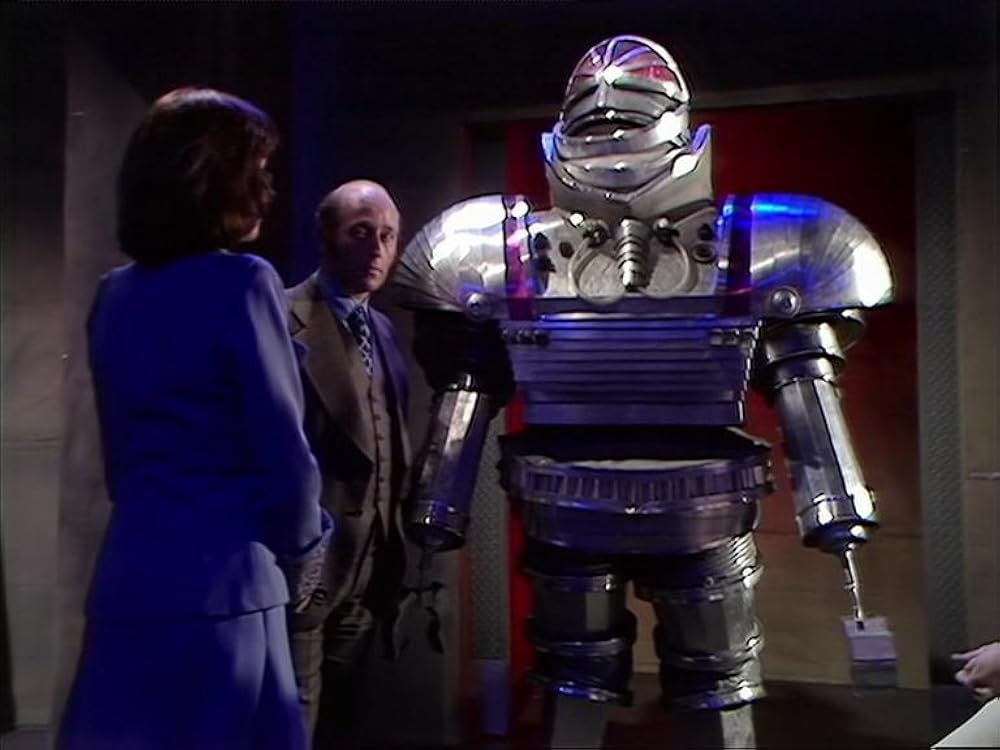
The Doctor is drawn into the investigation, and connects the robot to the mysterious crimes, which involved stealing parts and plans for a Disintegrator Gun. Eventually he discovers a plot by the Think Tank to use the robot and disintegrator gun to steal nuclear codes and hold the world’s governments to ransom.
While it doesn’t have the most original plot, Robot is a fast-paced, exciting first adventure for the new Doctor, and the titular robot is beautifully realised. Some of the other visual effects are sadly not so convincing, including one scene where there is a standoff between the robot and what is clearly an Action Man toy tank, and the finale, which is a homage to King Kong. The performances of the cast are generally excellent though, with good chemistry between Baker, Sladen and Marter. Robot also uses the Think Tank’s plot to bring up one of Doctor Who‘s recurring themes, that the end never justifies the means.
The Ark in Space:
Robot ends with the Doctor inviting Sarah and Harry to take a trip in the TARDIS with him. The rest of Series 12, while consisting of discrete stories, also forms a continuous storyline of that TARDIS voyage, with each story following directly on from the last.
The Ark in Space finds the TARDIS landing on an aging Space Station Nerva, more than 10,000 years in the future. The Doctor and Harry, separated from Sarah, explore the space station and discover that it is a type of Noah’s Ark, with humans and animals frozen in suspended animation to protect them from massive solar flares that scorched the earth.
Discovering that Sarah has been placed in one of the suspended animation chambers by the Ark, the Doctor and Harry search for a resuscitation kit. What they find instead is the mummified body of a giant, ant-like alien, a member of a race called the Wirrn, who can survive in the cold vacuum of space.
It is found that the Wirrn have eaten through the electrical cables of the control systems, and the Ark’s inhabitants have overslept by several thousand years. When the doctor repairs the circuits, a woman named Vira revives. She in turn revives Sarah and the leader of the space station, Noah.
What follows is an intense, frightening body-horror story. The Wirrn’s larval offspring are at large on the space station, and when Noah touches the creature’s slime trail, he becomes infected and begins to transform into a Wirrn.
I remember well the final scene of Episode 2 where Noah, staggering down the corridor of the space station, pulls his hand out of his pocket to reveal that it has turned into a hideous green tentacle. Re-watching this many years later I realised that said tentacle was constructed out of bubble wrap and spray painted green, but at the time it was utterly terrifying thanks to my youthful imagination.
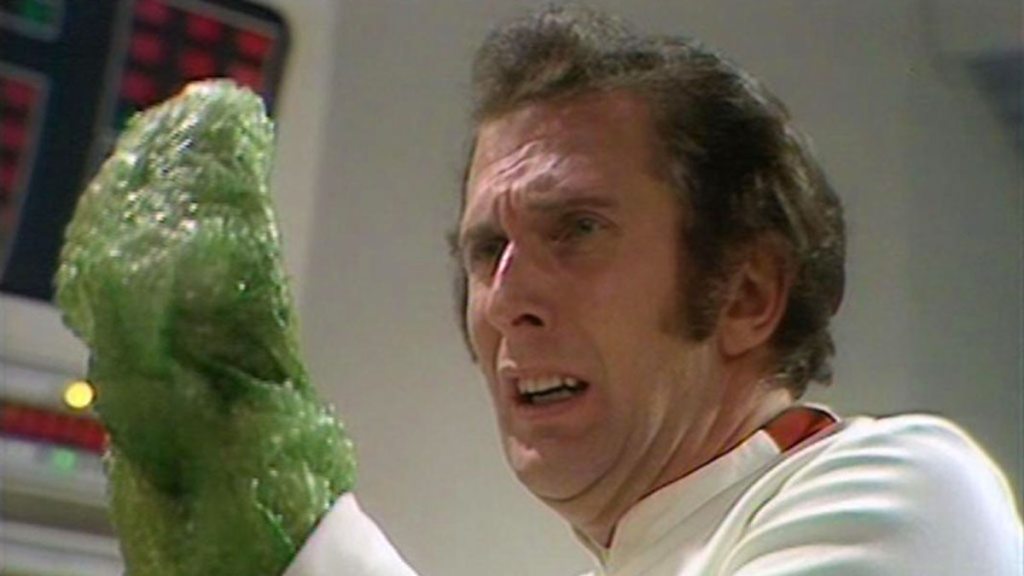
The Wirrn plan to absorb the human colonists and all their knowledge to become a technologically advanced race, and a tense standoff ensues as the colonists, along with the Doctor and his companions, battle with Noah and the Wirrn for control of the space station.
At the conclusion of The Ark in Space, Noah summons his last vestige of humanity to save the day, luring the Wirrn into the space station’s shuttle and flying into space before blowing it up. Without the shuttle, the colonists must rely on the transmat beam to get down to the now-habitable Earth. The Doctor notices that the receivers on Earth are unreliable, so he and his friends beam down so that he can repair them.
The Ark in Space is the first story to be headed by new producer Philip Hinchcliffe and script editor Robert Holmes. The dark, serious tone of the story is notable, and it is quite possible that this story may have been an influence on Ridley Scott’s Alien, released five years later.
The Sontaran Experiment:
Arriving on an unpopulated Earth, the Doctor begins repairing the transmat receivers while Sarah and Harry go exploring. Harry falls down a crevasse, and Sarah goes back to find the Doctor but instead meets an astronaut who tells her that he was captured and tortured by an alien.
The Doctor is himself captured by three more astronauts, who explain that they responded to a distress signal only to find their spaceship destroyed and a hostile alien picking them off one by one. This turns out to be Field Marshal Styre of the Sontarans, experimenting on humans to find their weaknesses in preparation for a full-scale invasion of Earth.
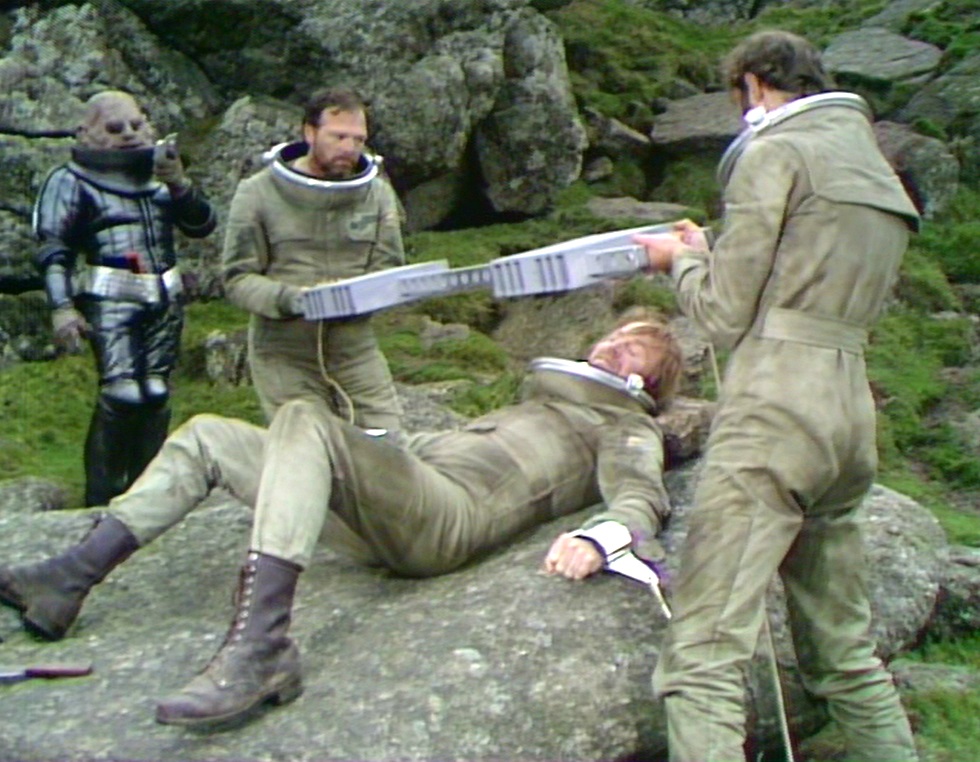
This two-part story may have a ridiculous premise (testing humans in preparation for invasion of a planet where there aren’t any) but it is a tightly-written adventure that delivers on the excitement and action. The choice to use South African actors rather than British for the astronauts is a nice touch, showing how the Earth’s accents may have changed over time. The visuals are generally impressive, with the exception of Styre’s rather wobbly robot.
Genesis of the Daleks:
At the end of The Sontaran Experiment we see the Doctor and friends using the transmat beam to go back to the Space Station. Episode 1 of Genesis of the Daleks, however, opens on a battle field on a distant planet. We find out that the Time Lords have intercepted the transmit beam to bring the Doctor to Skaro, home of the Daleks, at a point before their creation. His mission: to prevent the creation of the Daleks, or if that is not possible, to alter their history so that they do not become a supreme force for evil.
Genesis of the Daleks is, in my opinion, the stand-out story in this series. We meet the Kaleds and the Thals, two humanoid races living in domed cities and who have been locked in battle for a thousand years (despite their cities seemingly being within walking distance of each other!) The Kaleds are governed by the Elite Corps from an underground bunker close to their city. In this bunker, their chief scientist Davros is conducting experiments to create the ultimate living weapon – the Dalek.
Real-life Dalek creator Terry Nation always intended the Daleks as an allegory for the Nazis, and Genesis doubles down on this imagery, with the Kaleds stamping around in uniforms and jackboots, straight-armed salutes, ranting speeches about racial purity, eugenics and more. Michael Wisher is delivers a chilling performance as Davros, radiating evil even with his face hidden under a rubber mask.
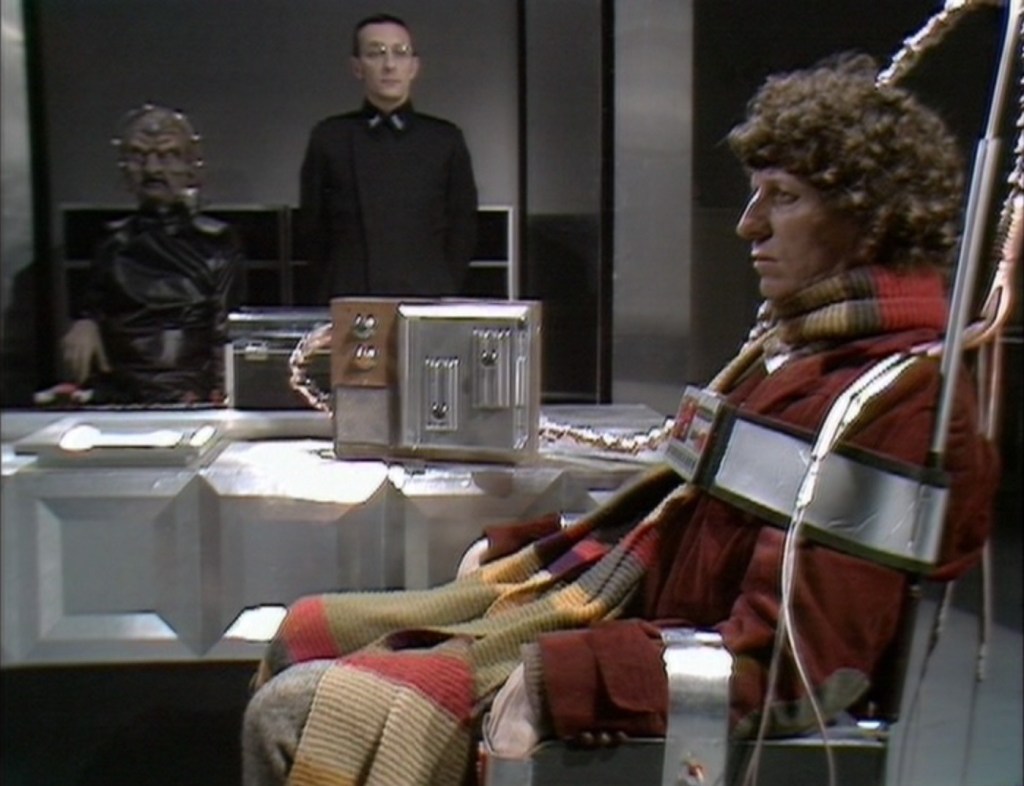
This story also gives us one of the most quintessential Doctor Who moments, where the Doctor wrestles with his conscience over whether he has the right to cause the destruction of the Daleks. If he wipes them out, does that make him no better than them?
There is so much to love about this story that one can forgive the odd dodgy special effect or cop-out cliffhanger resolution. Of course the Daleks live to fight another day, but the Doctor feels his mission has been a success because their progress has suffered a significant setback. The Doctor and his companions return to the Space Station using the Time Ring supplied by the Time Lords.
Revenge of the Cybermen:
The final story in Series 12 takes place once again on Space Station Nerva, though it is set thousands of years before the events of The Ark In Space. At this point, the station is being used as a beacon to guide space ships away from a drifting planet named Voga.
The Doctor and his companions arrive via the Time Ring to find the station in the grip of a mysterious plague which has killed most of the crew. The TARDIS is not present, as it is traveling back through time towards them. A crew member is attacked by a snake-like silver creature that the Doctor identifies as a Cybermat. He deduces that the plague afflicting the station’s crew is in fact poisoning caused by the Cybermat and its masters the Cybermen, who it turns out are at war with the inhabitants of Voga and wish to destroy their planet. The reason? Voga has vast reserves of gold, which is deadly poison to the Cybermen.
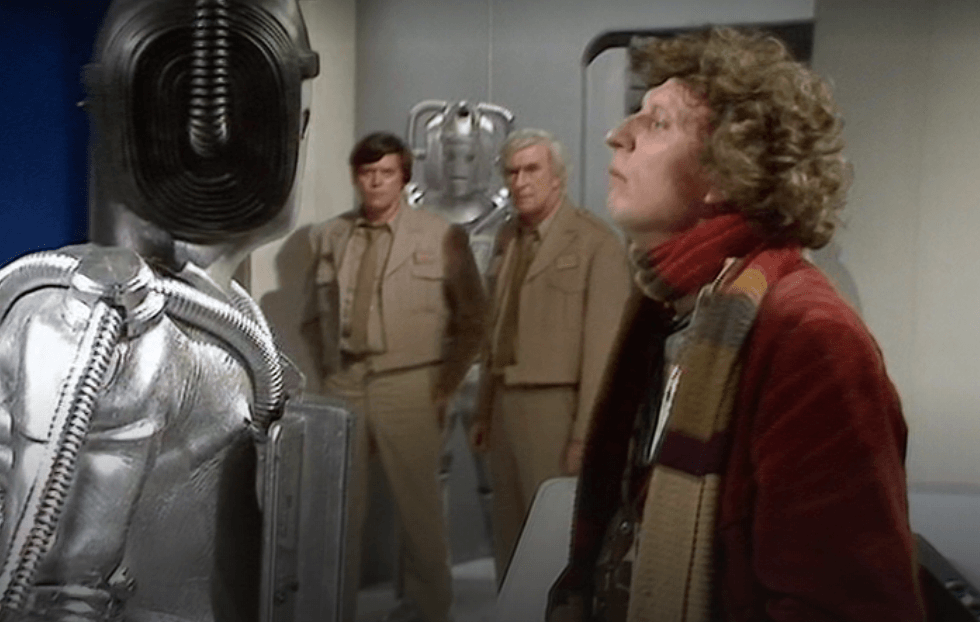
In my opinion, Revenge of the Cybermen is probably the weakest of the stories in this series. I remember watching it at the time and thinking it was good, with the cybermats and the plague they carried being suitably creepy. However, on re-watch the story just isn’t really all that interesting, even if the Cybermen are menacing villains and the cast all do their best, including Michael Wisher, once again masked, as Magrik, one of the Vogans.
Revenge ends with the Doctor being summoned back to Earth by the Brigadier, citing an emergency. This would have been the lead-in to the originally-planned series finale, Terror of the Zygons, but this story was eventually held over for Series 13.
Series 12, with its new production team, saw a definite tonal shift for Doctor Who. As I stated earlier, the stories became darker and involved more elements of horror, making Doctor Who a much more adult show. Subsequent series would further develop these themes, leading to some of Doctor Who‘s best viewership figures and several complaints to the BBC by self-appointed moral arbiter of the time Mary Whitehouse. The inclusion of several well-known villains in this series to compensate for an unknown Doctor was a wise move on the part of the BBC, and the series did well in the ratings. For me, Doctor Who had become must-see television.
I have re-watched the classic-era Doctor Who series several times over the years, and find the Hinchcliffe / Holmes era still stands up well today, even if modern visual effects technology make some of the old effects seem crude by comparison. The stories and the acting are still high quality and ultimately that is what carries the show. If you are only familiar with the show in its new, post-2005 version, check this series out. You may be very pleasantly surprised.
 Andrew Gilhooley's Blog
Leave a comment