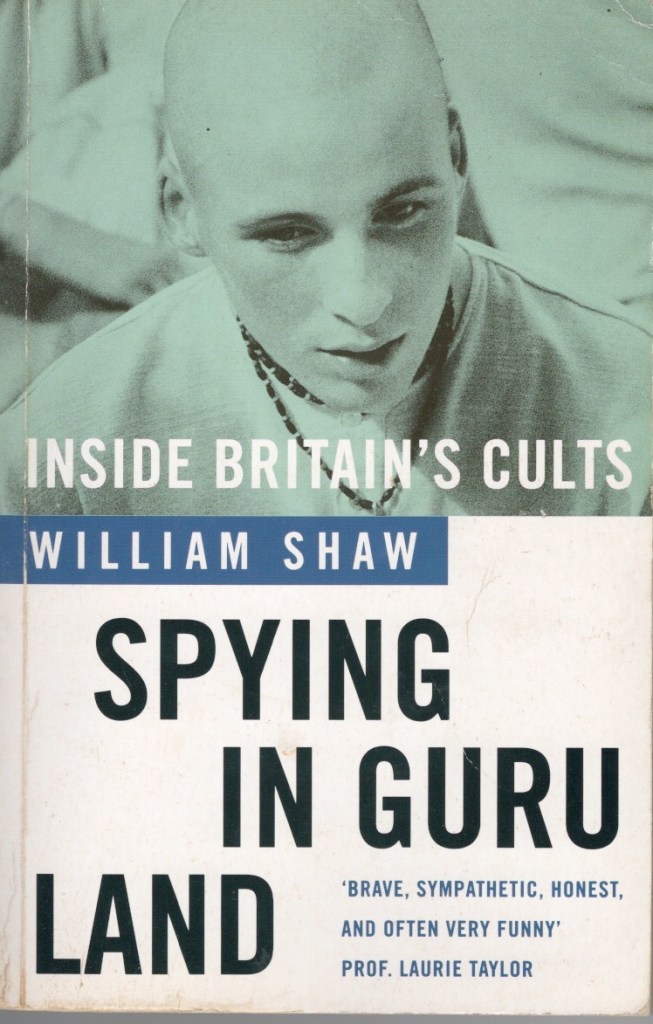
This is quite an unusual book review in that it is thirty years since I first read William Shaw’s account of the year he spent joining religious cults in and around London. What has prompted me to write about it after all this time was reflecting on my review of Lucy Brown’s Hate Club. In that book, she points out that the people who join extreme political groups often aren’t radicals or monsters but rather ordinary people who feel like they have been overlooked by the mainstream parties.
With certain aspects of the United States’ current, ultra-polarised political landscape often being described as cult-like, I was reminded of Shaw’s 1994 book and his observations about the people who join religious cults.
Shaw, a journalist for the American magazine Details (now out of print) as well as numerous British publications, became fascinated with the topic of religious cults after watching news coverage of the 1993 siege of the Branch Davidians’ compound in Waco, Texas. What, he wondered, inspired people to join organisations such as the Branch Davidians?
To try to find an answer, Shaw joined a number of groups in London and further afield. Some of them, like the Hare Krishna Temple, may be familiar to you. Others you may not have heard of before, such as the Aetherius Society or the School of Economic Science. He gives a brief history of each group that he joins as well as describing his experiences during his period of membership.
One particularly interesting encounter is with The Emin, a new-age group that practices tarot and aura reading, and delves into the hidden cosmic meanings of the most seemingly innocuous experiences and things. On a day trip with the group to an ancient castle, Shaw realizes an important lesson about cult behaviour. The new members are in a field, being taught to so “ancient Persian marches” by their instructor. Stamping across the field, he feels faintly ridiculous and, catching another member’s eye, realises that this person feels the same way. However, he observes,
Once the collective is formed, no one dares break ranks and say ‘Hold on. What We’re doing is really stupid.’ Once you’ve started tearing up reality, and rebuilding it in a different shape, you don’t want to step out of line or the whole precarious structure will crumble.
– Spying in Guru Land, page 38
As he spends more time with the Emin, Shaw increasingly encounters the members willingly complying with strange behaviours and rituals in order to feel like part of the group. While this may not necessarily be sinister in itself, it is one of the things he notices in several of the groups he joins – people will go to extraordinary lengths in order to feel like they belong.
Another group he encountered, the Jesus Army, was of particular interest to me because at the time I read the book I lived quite close to one of their communal houses in west London. After encountering the group at a large rally at Wembley Conference Centre, Shaw visits their house, and finds the intensity of the prayer meetings held there to be equal to that at the much larger gathering. He encounters people who have come in off the street, down on their luck, and immediately becoming committed members of the group, swearing to give their lives to Jesus. He realises just how easy it would be to get swept up in that intensity and excitement and plunge headlong into communal living without a thought of whether or not it was the best thing to do.
(As a footnote, after the Jesus Army founder Noel Stanton died in 2009, allegations of sexual, physical and financial abuse emerged against him and other leaders. The organisation has subsequently disbanded.)
Before he joined any of these groups, Shaw says he was expecting to find the stereotypes that we all imagine when we think of cults: manipulative leaders duping their brainwashed followers. Instead, he says, what he mostly found was ordinary people who were searching for something – a deeper meaning to life perhaps, or a sense of belonging.
The book also includes interviews with ex-members of a number of cults, describing both their positive and negative experiences of their time in the various groups, including one person who was present at the Waco siege. He also discusses the anti-cult movement and deprogramming in some detail, and interviews some self-styled cult experts.
Overall, Spying in Guru Land gives a sympathetic, balanced and most importantly non-sensational look at some fringe religious groups and the people who join them. It handles its topic with sensitivity and humour, and is possibly the best overview of the world of non-mainstream religions that I have read. It is out of print now, but used copies are easy to find online. As it is 30 years old, the book is also interesting in that it was written before many of the all-pervading technologies that we live with every day existed, prompting the modern reader to wonder what Shaw’s experience might have been like today.
 Andrew Gilhooley's Blog
Leave a comment