On 25th August, 1975, I watched Tom Baker, in character as The Doctor, sitting in a cinema presenting clips from Disney films in the August Bank Holiday edition of Disney Time. At the end of the show, a hand was seen passing him a note. He read the note and announced “It’s from the Brigadier. He’s in trouble again!” Exiting the cinema, he bid goodbye to the audience and promised that he would see us again soon – “next Saturday in fact” – before dematerialising in the TARDIS.
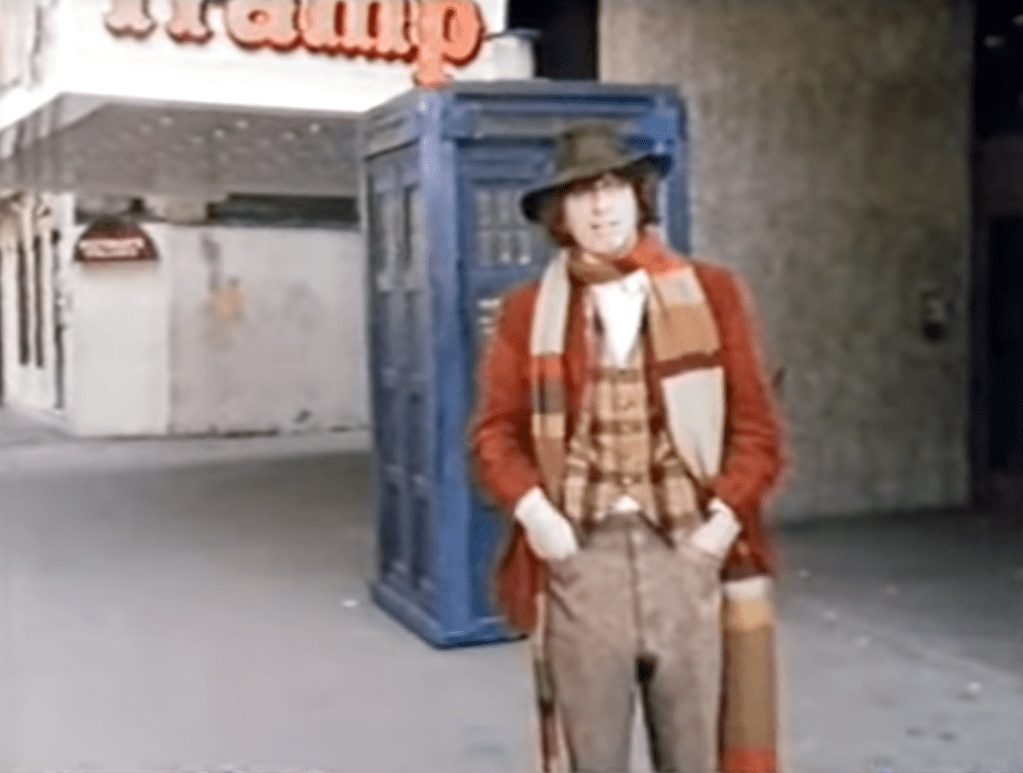
The following Saturday, 30th August 1975, Series 13 of Doctor Who kicked off with the first episode of Terror of the Zygons. Originally held over from being the Series 12 finale, this story takes the Doctor and his friends to Scotland, where UNIT is investigating a number of oil rigs that have been mysteriously destroyed.
The Doctor soon discovers evidence that the rigs have in fact been attacked by a very large creature. This turns out to be the Skarasen, a huge, cybernetically enhanced beast brought to Earth hundreds of years ago by a race of shape-shifting aliens called the Zygons. The Zygon ship was damaged and was forced to crash land in Loch Ness. Sightings of the Skarasen over the years have given rise to the legend of the Loch Ness Monster.
The Zygons had been living secretly under the Loch until recently, when they learned that their own planet had been destroyed. The Zygons now plan to conquer the Earth and terraform it to their liking, making a new home for their race.
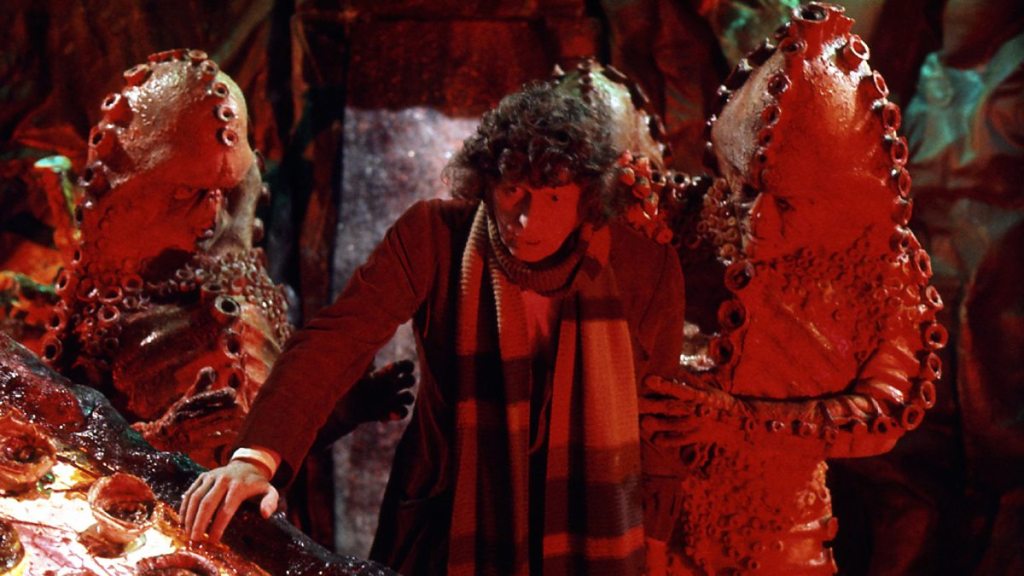
Terror of the Zygons is a gripping start to the new series, full of excitement and misty, gloomy atmosphere, with West Sussex admirably standing in for Scotland. The Zygons and their spaceship are beautifully realised, though the same unfortunately cannot be said for the Skarasen – a common problem for large monsters in Doctor Who: they tend to look like the puppets they are.
This story marks the end of Harry Sullivan’s travels in the TARDIS, and is also the last true UNIT story of the classic era, though both would make at least one more brief appearance in this series. As is often the case in this era of Doctor Who, Terror of the Zygons includes some wry observations about topics such as social class, tradition, environmentalism and the human race’s reliance on fossil fuels.
Next up is Planet of Evil, in which the Doctor and Sarah answer a distress call from the jungle planet Zeta Minor, 30,000 years in the future. Scientists have been mining anti-matter crystals to use as an energy source, and all have vanished except their leader, Professor Sorenson. A military rescue mission arrives at the same time, and initially suspect the Doctor and Sarah of being behind the disappearances. However, the real culprit is soon revealed – an invisible creature from the universe of antimatter.
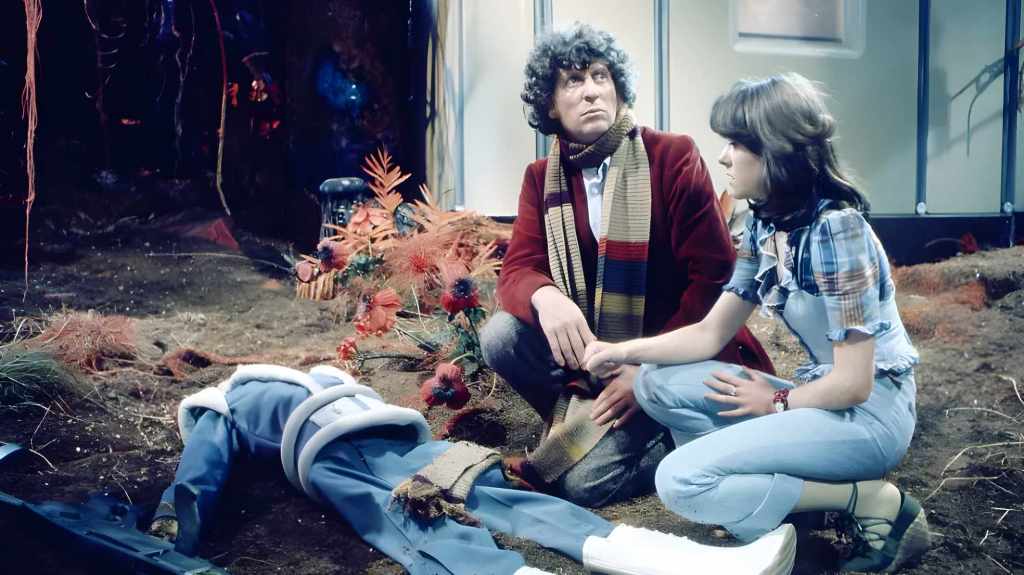
Planet of Evil is another beautiful-looking serial, with the jungles of Zeta Minor rendered in exquisite detail. Heavily influenced by Forbidden Planet and Dr. Jekyll and Mr. Hyde, the story has some genuinely creepy elements, including the semi-unseen anti-matter creature and Professor Sorenson’s transformation due to exposure to the anti-matter crystals. It was all pretty scary stuff to my eight-year-old self!
The horror continues in the next adventure, The Pyramids of Mars. Inspired by the Hammer horror movies The Mummy and Blood from the Mummy’s Tomb, this story sees the TARDIS pulled off course and landing in 1911 England, on the estate of archaeologist Marcus Scarman.
Scarman has mysteriously disappeared during an excavation of a tomb in Egypt, where he unwittingly discovered a link to Mars, where Sutekh, the last of the Osirans and the inspiration for Set in Egyptian mythology, is being held prisoner for his terrible crimes. Now a corpse possessed by the will of Sutekh, Scarman is attempting to free him from his prison by constructing a rocket to Mars, assisted by several robotic mummies.
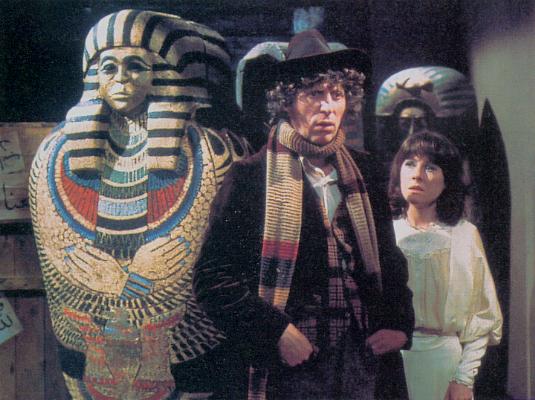
The Doctor and Sarah, along with Sharman’s brother Laurence and his friend Dr. Warlock, must try to destroy the rocket before Sutekh is freed to wreak havoc in the universe.
Pyramids of Mars is one of the most highly regarded stories of the classic era, and is an almost flawless blend of science fiction and horror. Once again beautifully filmed and with outstanding performances from the cast, it is a gripping adventure from start to finish.
The next story in the series, The Android Invasion, mines another of sci-fi and horror’s favourite scenarios, the creepy little village. In it, the Doctor and Sarah arrive in a quaint English village that seems strangely quiet. They encounter a group of white-suited, helmeted figures that pursue them, firing bullets at them from guns built into their index fingers.
To escape their pursuers, the Doctor and Sarah run into a pub, where all of the customers are sitting, motionless and silent, until the clock chimes, whereupon they all come to life and start behaving normally. In their subsequent investigation, the Doctor and Sarah find out that they are not on Earth at all, but in a duplicated village being used by Styggron, leader of the Kraals, to test his plan to invade and conquer the earth using a deadly virus.
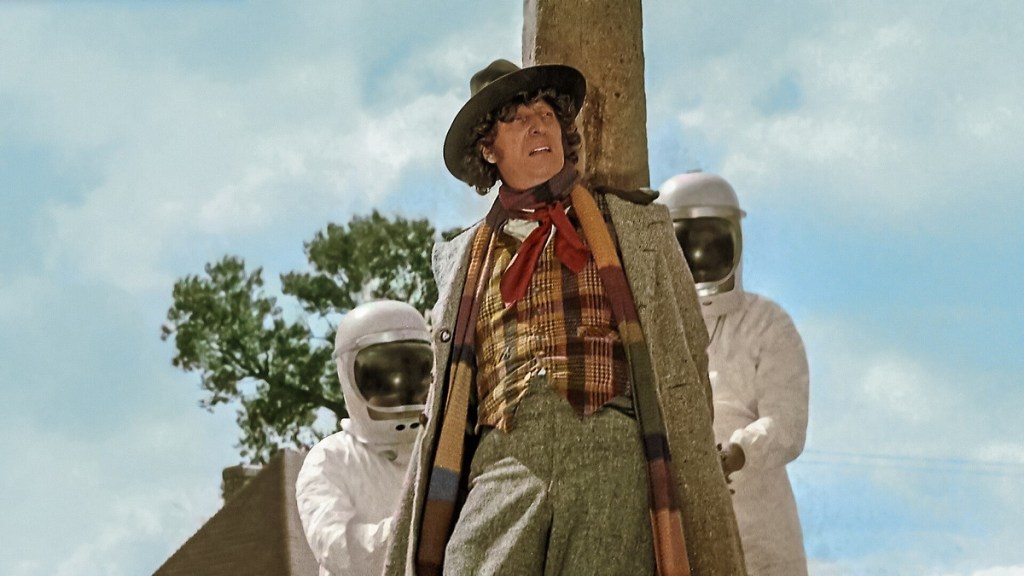
The Android Invasion is probably the weakest story in Series 13 thanks to its fairly ludicrous plot, a practice invasion similar to the one in The Sontaran Experiment. It’s still quite an exciting romp, however, and I remember at the time really liking the white-suited androids with their finger guns. Interestingly, the serial was written by Terry Nation, and is both his first script since 1964 not to feature his creation the Daleks, and his penultimate script for the show. It also features guest (and final) appearances by Ian Marter as Harry Sullivan and John Levene as Sergeant Benton. Nicholas Courtney was unavailable to reprise his role as the Brigadier, so the character was changed to Colonel Faraday.
We’re back to gothic horror for the next offering, The Brain of Morbius, which is Doctor Who‘s riff on the classic horror story Frankenstein. Here, the Time Lords drag the TARDIS off course to the planet Karn, where the Sisterhood of the Flame jealously guard the Elixir of Life, which grants them immortality. Using their psychic powers, they drag spaceships to their doom on the planet’s rocky surface.
Meanwhile in his castle, mad scientist Mehendri Solon (a great performance by Philip Madoc) and his hook-handed servant Condo are using the body parts from the crashed spaceships’ inhabitants to create the ultimate body to house the brain of Time Lord war criminal Morbius, which he is keeping alive in his cellar. When the Doctor and Sarah arrive at the castle, Solon decides that the Doctor’s head would be the perfect container for the brain.
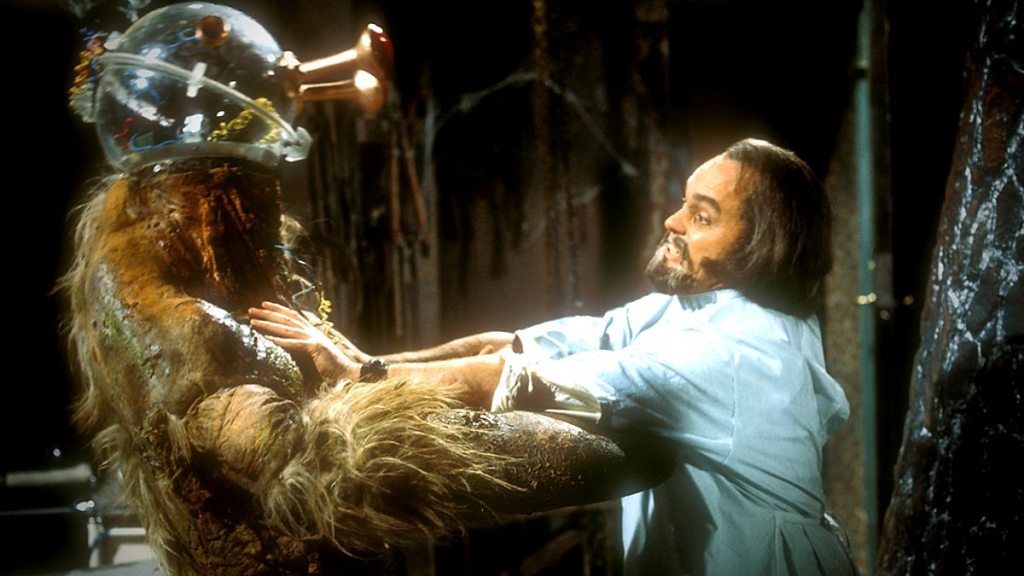
The Brain of Morbius is another stand-out example of this era in all its gruesome, gothic glory. Campaigner Mary Whitehouse was quoted as saying that the story “contained some of the sickest and most horrific material seen on children’s television”. You can’t get a better recommendation than that!
The sixth and final story in Series 13, The Seeds of Doom, is an action adventure story in the vein of popular 1960s series The Avengers. In it, the Doctor undertakes one last mission as UNIT’s scientific adviser, to investigate a strange seed pod uncovered by an Antarctic expedition. A scientist working on the pod has seemingly been infected by it, and his body is undergoing horrific changes. The Doctor identifies the pod as from a Krynoid, a carnivorous alien plant species that, if left unchecked, could destroy all animal life on Earth.
While the Doctor and Sarah are trying to help the scientists, a second pod is discovered buried in the ice. Word of this pod gets, via a government mole, to multi-millionaire Harrison Chase, who is obsessed with rare and exotic plants. Wishing to own the pod at any costs, he dispatches a gang of thugs to Antarctica to retrieve it. They arrive to find the scientist is now transformed into a Krynoid, and is at large on the base.
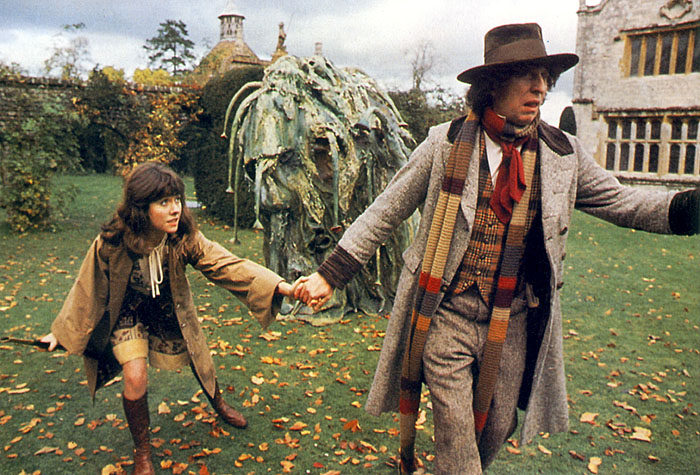
The Seeds of Doom splits its action between Antarctica and Harrison Chase’s estate in England, where a second Krynoid gets to run rampage. Tony Beckley as Harrison Chase gives a stand-out performance in the vein of a James Bond villain, playing the organ in his cathedral-like greenhouse and attempting to put the Doctor and Sarah through the whirling blades of a composting machine.
Unusually, this story sees the Doctor getting into fisticuffs with the villains and even brandishing a pistol at one point. There’s no shortage of action and excitement, and even if the resolution of the story is a bit of a let-down (stock footage of fighter jets firing missiles representing an attack on the now giant Krynoid by UNIT), the explosion of the mansion and Krynoid is a satisfying climax. The Seeds of Doom is a worthy closer for the Fourth Doctor’s second series.
Series 13 is Doctor Who at its best. Tom Baker is really hitting his stride as the Fourth Doctor here, and cementing his place in the show’s history. Elisabeth Sladen as Sarah Jane Smith is the perfect foil to the Doctor’s character, and the regular supporting cast are excellent too. I was sad to see Harry and UNIT go at the time, and still sad whenever I rewatch.
Philip Hinchcliffe and Robert Holmes are hitting their stride too, mining the classics of science fiction and horror, and reinterpreting them through a Doctor Who lens, presenting consistently good stories that stand up well to repeat viewing. Watching these serials again leaves me in no doubt that these were the golden years of the classic era. If you came to Doctor Who only after the 2005 revival, watching Series 13 will show you just how good the original show could be.
 Andrew Gilhooley's Blog
Leave a comment