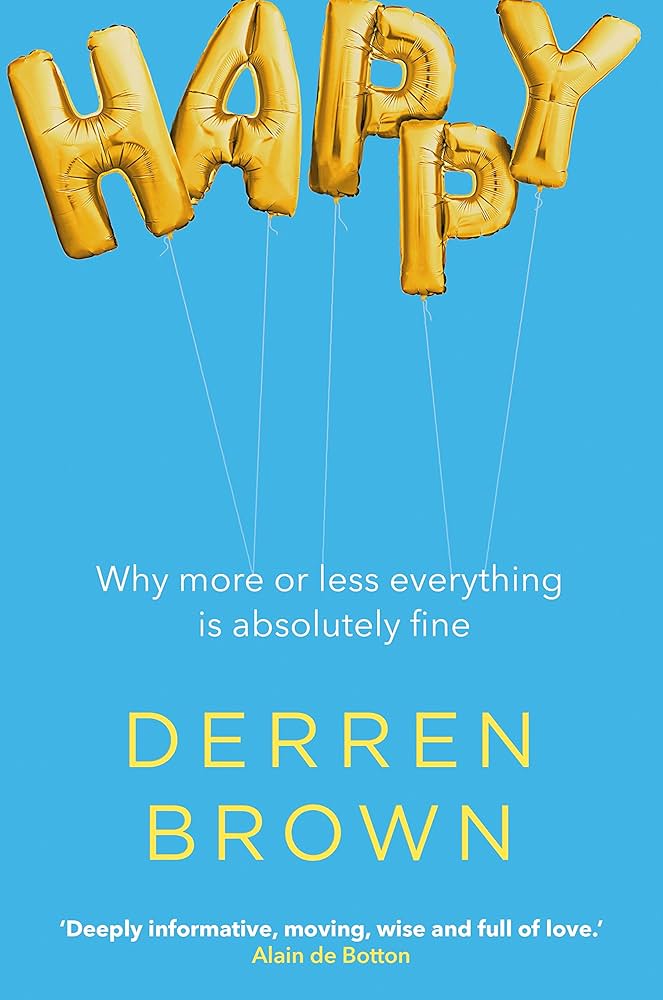
Happy by Derren Brown is another book that I bought when It came out but took a long time to get around to actually reading. I read about a third of it back in 2016 before getting distracted by something else and putting it back on the shelf. It was only recently, during a particularly challenging period of my life, that I picked it up again, perhaps intrigued by its subtitle “Why more or less everything is absolutely fine”.
Derren Brown is not nearly as well known here in the US as he is in his native UK, so it’s worth spending a minute explaining who he is. He is not, as you might think, a motivational speaker, life coach or anything similar, but rather an illusionist who came to prominence around the turn of the millenium. In his stage and television performances, he appears to be able to read people’s thoughts, influence and predict their behaviour, and perform amazing feats of memory. Brown claims no supernatural or psychic abilities but rather that he achieves his effects through a combination of stage magic techniques, psychology, suggestion and showmanship.
Brown’s early television specials saw him play Russian roulette, recreate a Victorian seance and convince a team of company executives to stage a security van robbery. Later in his career, he started to focus his work more on the power of the mind and how people’s thinking could affect their lives in both positive and negative ways. His shows explored topics like the placebo effect, faith healing and ways in which people overcame their fears.
In Happy, Brown continues these explorations by turning his attention to the notion of happiness and the emphasis society places on it.
Everybody says they want to be happy.
But that’s much more easily said than done.
What does being happy actually mean?
And how do you even know when you feel it?– Derren Brown, Happy jacket copy
Brown begins his book by looking at our society’s focus on positive thinking in all its various forms. Among others, he cites Rhonda Byrne’s The Secret and its notion that by simply concentrating on what you want you can bring it into your life. He contends that ideas like these cause self-blame and unhappiness when they do not work – clearly we just weren’t concentrating hard enough. Brown similarly discusses goal-setting and other motivational techniques as often having a similar problem: Once we have arrived at the goal, say a new house or job, are we really any happier? Perhaps initially, but then we slowly realize that we are still the same person – as the old saying goes, “wherever you go, there you are”.
Brown spends the next part of the book discussing what various philosophical schools of thought have had to say about happiness, from Socrates and Plato, Aristotle, the Stoics, Christianity, the Enlightenment and others, all the way to today. For each approach, he evaluates its pros and cons, noting that no school of philosophy has all the answers for every situation.
If we recognize, he says, that happiness comes not from attaining something in the future but how we are living in the present, this gives us a starting point to explore from. He then returns to the Stoics and their world view that firstly, it is not the events in our life that cause us sorrow but our reactions to them, and secondly that we should not try to change the things in life over which we have no control. The things in life that we have control over are our own thoughts and actions; the things we have no control over amount to pretty much everything else.
Recognising this distinction can be a key tool in navigating life’s trials with equanimity. For example, we may desire a new position at work, and make our best efforts to secure the promotion by doing the best job that we can so that our boss notices us, but ultimately we must recognize that the decision about who gets promoted is theirs, not ours. Detachment from the outcome of something that we ultimately cannot control enables us to live more fully in the present.
Brown continues his discussion of these building blocks of Stoicism for several chapters, covering such topics as looking at things from different perspectives, empathy and dealing with feelings of anger and hurt when they arise.
He then turns to the topics of wealth and fame, and whether these contribute to one’s happiness or otherwise. Many studies have shown that beyond a certain point where a person’s needs are met, more money does not make the person significantly happier, and that the pursuit of wealth for its own sake can make a person miserable as they will never have enough.
As for fame, Brown reflects on his own experiences and observes that like most things, fame has its positive and negative aspects. Once again, he reminds us that even if we achieve fame and/or wealth, we remain the same person inside. He also astutely comments that fame ultimately depends on other people’s desire to behave a certain way towards you, and that fame can be fleeting, so pursuing it for its own sake may again be a recipe for unhappiness.
The Stoics would argue that it is a far more worthwhile pursuit to work at being good at one’s craft and to let any fame or financial reward be a side effect of your work’s quality rather than one’s singular aim.
The final topic in Happy is death, which Brown discusses with humanity and compassion. He discusses the reasons we might fear death, and why people might or might not believe in an afterlife and what they imagine that may be.
He also recounts his conversations with a terminal cancer patient and her family, whom he befriended after they came to one of his performances. In this touching section, he describes how she was facing the inevitable with dignity, and how much she appreciated the time she spent with her loved ones.
The conclusion of the book is that happiness can perhaps only be achieved by living as best one can in the here and now because ultimately this is all we have. The Stoic philosophy can offer some useful tools for helping us navigate life, but once again Brown cautions the reader against self-labelling, which can be limiting.
Overall, I found Happy to be an enjoyable, thoughtful book that prompted some useful self-examination and evaluation. It’s not a self-help book as such, but rather a discussion of some ideas and tools that may help the reader to gain a different perspective on what it means to be happy. It is certainly a useful jumping-off point for reading about the various schools of philosophy, and contains an extensive bibliography. It is also interesting to read Brown’s personal reflections on some of the topics, though the book is not as autobiographical as his previous works.
At 442 pages, Happy is not a quick read. Recognising that some readers might be put off by the lengthy discussions of philosophy, in 2020 Brown published A Little Happier, which condenses some of the ideas in Happy into 120 pages, with shorter chapters that are easier to dip in and out of.
Whichever you choose, you’ll find much to interest you and stimulate your thinking in Derren Brown’s rumination on what it means to be happy.
 Andrew Gilhooley's Blog
Leave a comment