When I stared my new blog back in July of last year I didn’t intend it to be a nostalgia blog as such. However, as it turns out, a lot of my posts have been about my memories of growing up, of books, television and so on that I enjoyed in my youth. So be it; it’s probably one of the byproducts of middle-age that one tends increasingly to look back on one’s life and younger days, at all of those past experiences that may never be repeated or experienced again in the same way. If you’re writing about your history, it takes a lot to stop nostalgia creeping in there.
The word nostalgia has its roots in two Greek words: νόστος (nóstos), meaning “homecoming” and (álgos), meaning “pain”. It was originally used by the medical profession to describe the intense homesickness experienced by some soldiers serving overseas. Over time, however, this “the pain of homecoming”, took on a more general meaning as a yearning for the past and the combination of pleasure and melancholy often felt on looking back on it.
Several years ago, when I was clearing my mother’s house out after she died, I found many items that held strong memories for me. So many, in fact, that it was difficult to decide what to throw away and what to ship back to the United States. Seeing things like my old Chemistry set reminded me of how interested in science I was as a young boy, and how that led me to study chemistry at college and become a science teacher. The mixture of pleasure at seeing my old things and sorrow at the passing of time and its inescapable attendant losses was potent.
Actually, my old Chemistry set provides a good example of the pleasure and pain of nostalgia. When I was about nine or ten years old, there was probably nothing I wanted more than the Thomas Salter Chemistry Set Number 7.
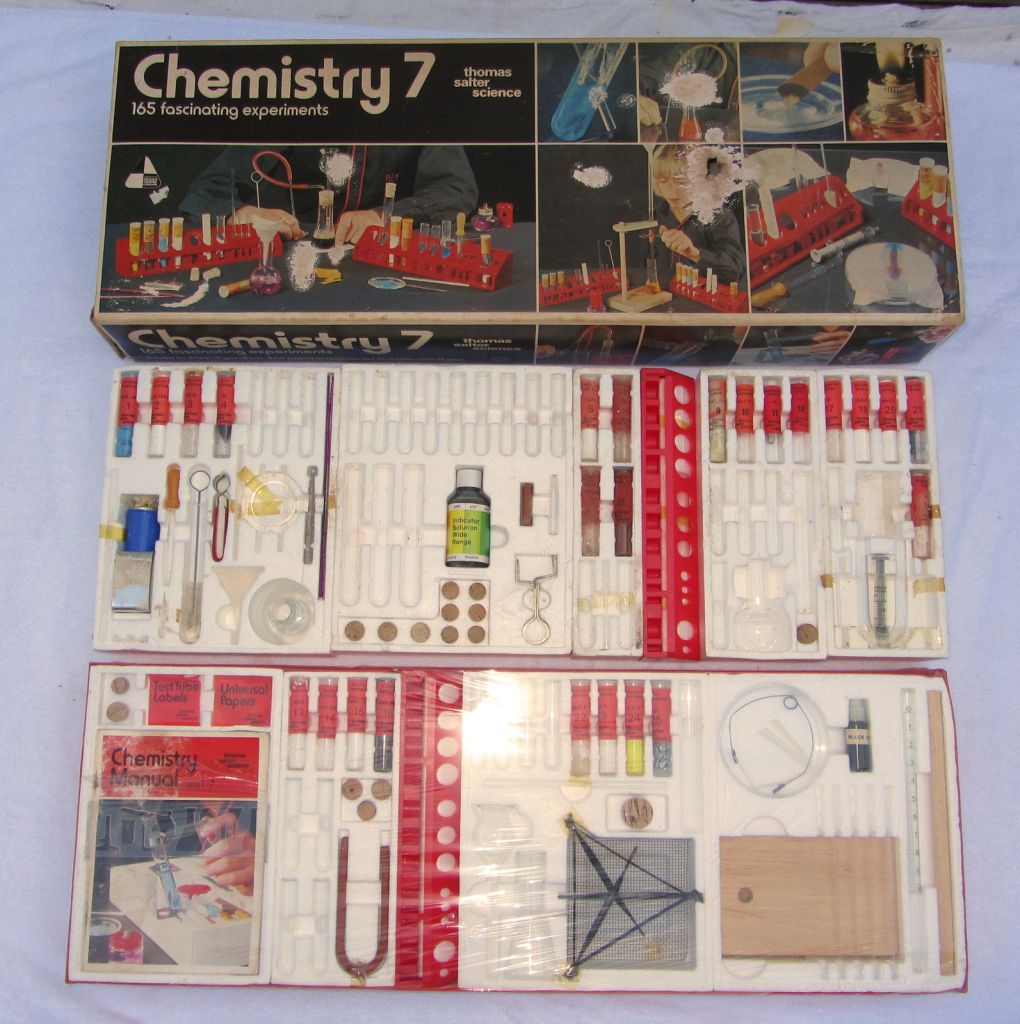
That thing was enormous; it looked like I could have turned my bedroom into a full-scale laboratory! Every time I got to go to the toy department at Bainbridge in Newcastle I would gaze longingly at its box, with its photographs of fascinating experiments in progress. However, Chemistry 7 was expensive, and our family budget only ran to a far more modest set. Nevertheless, it was the Holy Grail to my young eyes.
Fast forward many years, and I saw Chemistry 7 for sale on eBay. It was expensive, but I could have afforded it and would probably have bought it had not there been customs restrictions on sending such items from the UK to the US in the mail. However, by not buying it I probably saved myself some disappointment.
Why? Because it would have been my fifty-something self, not my ten-year-old self, owning the set. I might have admired it, and thought “wow, ten-year-old me would have loved this!” but that was it. I don’t think I would have put on my safety goggles and tried any experiments – the set would have gone on a shelf to be occasionally admired and be a trigger for youthful reminiscence, that’s all.
In a similar vein, at an about the same age that I was lusting after chemistry sets, a series of science-fiction themed toys called Micronauts came out. They were unique in that the toys could be taken apart and reassembled to make new spacecraft, and parts could be interchanged between one toy and another, giving endless possibilities.
Did I just say that the thing I wanted most in the world was Chemistry 7? Yeah, add to that list the toy from this line that I wanted most – the Mobile Exploration Lab:
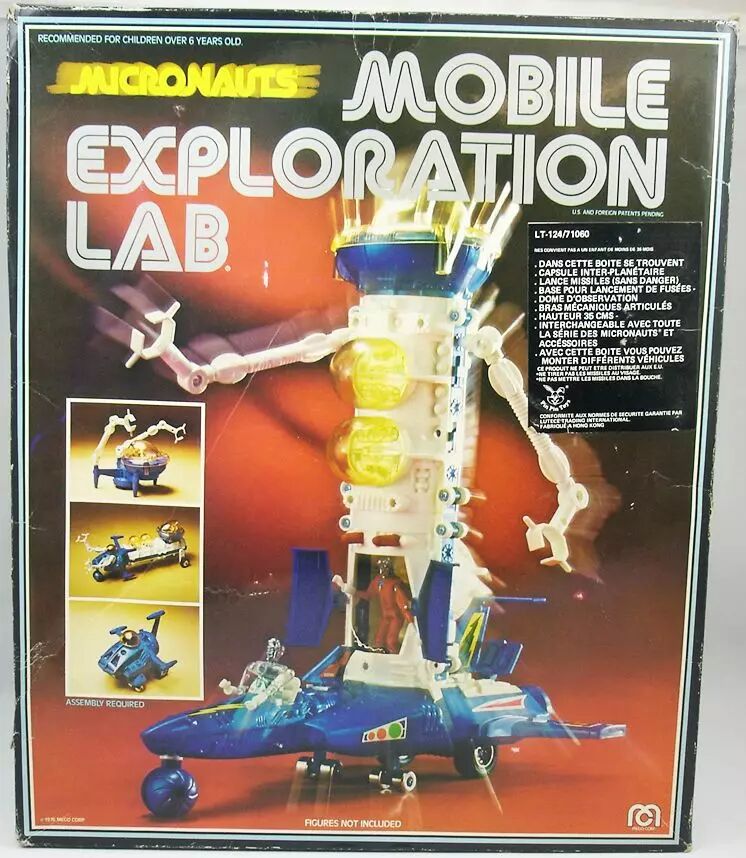
Doesn’t that look impressive? It was over a foot tall and featured a whole host of bits and pieces including a rocket launcher that fired foam-tipped missiles. I had wanted one for a long time, ever since it came out a year or two previously, and pleaded with my mother to buy it for me for Christmas. She did, all the while probably knowing that by that time I was on the cusp of becoming too old for such things and that my time of playing with it would be relatively short. I would eventually give it, along with some other Micronauts toys, to a younger relative.
I recently read a book which contained a scene that captured this perfectly. In Please Tell Me by Mike Omer, a child psychologist is doing play therapy with a young kidnapping victim. She visits her domineering mother’s house and takes, against her mother’s wishes, an antique doll house to use in the therapy. As a child, she had never been allowed to touch the doll house, and she now feels simultaneously the pleasure of having it in her possession as an adult and the sorrow that she will never be able to play with it. The time she could have done that has passed and is gone forever.
I recount these stories because they illustrate to me some inescapable facts about life and the human condition. That time, so far as we know, only moves in one direction, forwards, and that we can never truly recapture a moment, no matter how much we might desire to – and we always desire to. This is the very nature of nostalgia, that the pleasure of our metaphorical homecomings is always tempered with the sadness of loss, and perhaps why we continue to pursue them, to find meaning in our lives.
 Andrew Gilhooley's Blog
Leave a comment