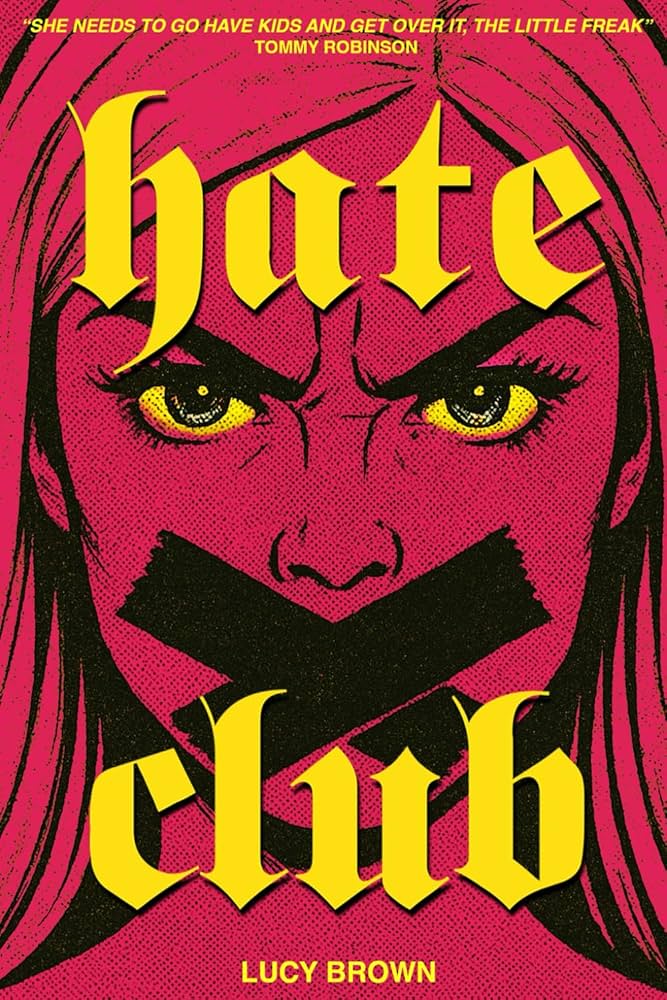
In her memoir Hate Club, author Lucy Brown takes us back to 2016, and a Britain in turmoil. The Brexit referendum, racial tensions, fear of Islamist terrorism, concerns over immigration, and the increasing likelihood that Donald Trump would be successful in his bid for the White House all had Britons feeling uncertain about the future. Brown, working as a photographer in London, was herself reeling following her recent escape from an abusive relationship.
Following some discussions of social issues at work, Brown gets involved with some left-leaning causes including attending a Black Lives Matter protest. While she likes the atmosphere at the march, she is less impressed with the behaviour of the people at the various meetings she attends, as they silence anyone who dares to question group orthodoxy.
As 2016 rolls on, Brown finds the language of these political groups creeping into everyday life, with terms like “hate speech”, “microaggressions” and “mansplaining” coming into everyday use and people in her workplace and elsewhere calling each other out for the smallest perceived transgression. The world was starting to feel to her like an unfriendly place, “like everyone had taken asshole pills”.
She first encounters the far-right after attending a protest against an art gallery accused of hosting “alt-right” speakers. She films a young man holding a free speech sign and being intimidated by a mob of people and uploads the footage to YouTube. Soon, she is contacted by two men from Rebel TV, a right-leaning Canadian media group.
It is here that Brown’s story begins in earnest as she starts working with Rebel TV, producing the kind of citizen journalism that was still relatively new in 2016. She soon encounters Tommy Robinson, former leader of the English Defence League and national figure of the far right. She and her Rebel TV colleagues end up running Robinson’s media campaign, and the bulk of the book is a no-holds-barred account of what it was like to work for one of Britain’s most notorious and polarising figures.
Though there may be much that is shocking in this book, there is not much that is surprising. We find out all about Robinson’s erratic behaviour, his drug abuse, his marital infidelity and that his true motivations seem to be fame and self-enrichment at the expense of others including his team.
In one particularly affecting scene, Brown and her team are unpacking boxes sent by supporters from Robinson’s Amazon wishlist. We discover that Robinson has a follower with so little money that the only item on the list they could afford was a pack of AA batteries, which comes accompanied by a note apologising for how small the donation is but stating that the donor wanted to help Robinson’s cause in any way he could. Later we find Brown remembering this incident as she realises that Robinson was using his campaign donations to fund luxury cars and designer clothes for himself while not paying his employees their wages.
It all eventually unravels for Brown after the Day For Freedom rally in London in May 2018, when she is blamed for the attendance of controversial YouTuber Ali Dawah (it was, in fact, at Robinson’s request) and sacked from the team. What follows is a brutal online hate campaign with false accusations, doxxing and more, led by Robinson and her former colleagues. Brown tries her best to disappear from online life for a while before coming back for one more round of working with Robinson, the discovery of more betrayal and her eventual leaving of the group for good.
As the author says, Hate Club is not the “I joined the far right and now I regret it” account that you might expect. Instead, Brown gives an unflinching view into that world and also that of the radical left. As a reader, I am left with the impression that the two sides are more alike than they are different. She also looks at the media’s role in politics, how it dictates the issues that are and are not acceptable to discuss, and the spin that the stories are given. Finally, she gives valuable insights into how average people, frustrated with mainstream political parties that they feel are ignoring their concerns, can be swayed into following those with more extreme positions that promise solutions.
It feels strange to be publishing this book review today. Only yesterday here in the US, right-wing activist Charlie Kirk was murdered at a rally by an as-yet unknown gunman. This has been just the latest in a series of politically-motivated violent acts. Just three months ago two Democratic lawmakers in Minnesota and their spouses were shot in their homes; one couple was killed, the other injured. Just two months before that, the Pennsylvania governor’s house was set on fire while the governor and his family slept inside. Everyone was safely evacuated. The list of incidents goes on and on, and the country only seems to be becoming more and more polarised politically.
As the political worlds of the US, the UK and elsewhere become ever more chaotic, Lucy Brown’s Hate Club is a relevant and timely read.
 Andrew Gilhooley's Blog
Leave a comment